SELECTED WORKS
Selected Works
Three books · From the New Third Board to Civilization Structure Theory
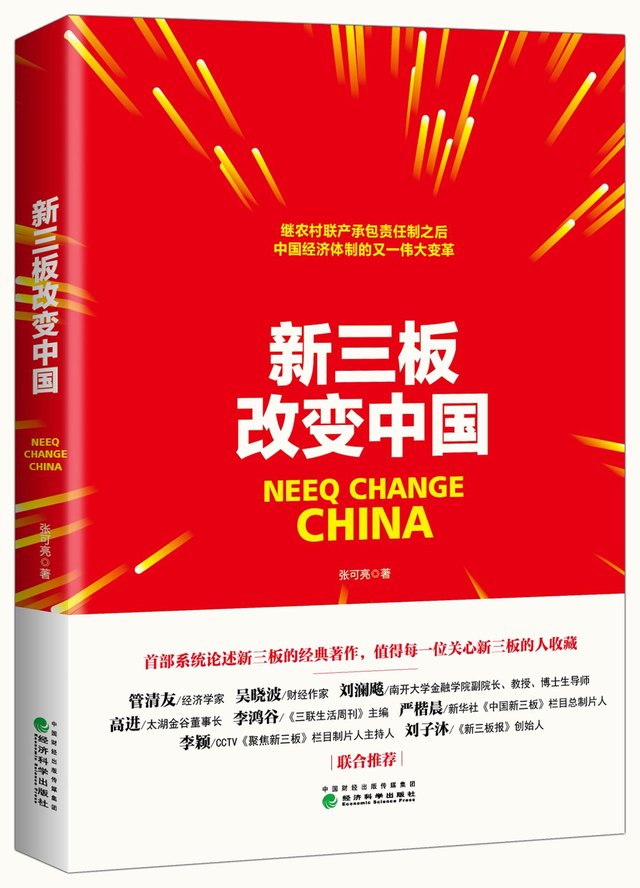
New Third Board Changes China
NEEQ Change China · Economic Science Press · November 2017 · ISBN 978-7-5141-8725-0 · 309 pp.
Another great transformation of China's economic system, after the household responsibility system in the countryside
This is the practical starting point of the Civilization Structure Theory system. It is not a simple introduction to the New Third Board, but uses the building of the New Third Board as an entry point, analyzing it to reveal the problems and the way out for China's capital markets, and the path and method of China's socio-economic reform. Against the backdrop of China's shift between old and new growth drivers, the author boldly redefines China's capital market— the New Third Board is not China's "Nasdaq," but will and must be a capital market with Chinese characteristics.
The book offers a systematic critique of the mainstream economic views then popular in the market and media, and argues: the new economy brought by new technology demands new capital, new institutions and new theory. Chapter Five, "The Theoretical Debate on China's Economic Development," first presents "Cultural and Political Economics: A New Theoretical Framework"— the earliest embryo of what later became the Civilization Structure Theory system.
Endorsements
The New Third Board is a major capital-market reform and innovation of a new era; it has attracted a large number of financial-industry innovators of vision and ideal, among whom Zhang Keliang is undoubtedly one of the very best. … I believe New Third Board Changes China will surely become a classic among classics in its field.
— Guan Qingyou, economist
Keliang places the New Third Board against the backdrop of China's new round of deepened reform. Starting from the relationship between finance and the real economy, he boldly hypothesizes and carefully verifies the historical mission of the New Third Board, and proposes a possible evolutionary path for China's capital-market reform. At a time when the New Third Board is far from consensus, this rational thinking and persistent exploration are especially valuable.
— Wu Xiaobo, financial writer
Jointly endorsed by: Guan Qingyou · Wu Xiaobo · Liu Lanbiao (Vice Dean, School of Finance, Nankai University) · Gao Jin (Chairman, Taihu Golden Valley) · Li Honggu (Chief Editor, Sanlian Life Weekly) · Yan Kai-chen (Chief Producer, Xinhua's "China NEEQ") · Li Ying (CCTV "Focus on NEEQ" producer & host) · Liu Zishui (Founder, NEEQ Report)
Table of Contents
- Introduction
- Foreword by Another · A Call from the Ideal State
- Author's Preface · A Scholar's Path into Investment Banking
- Chapter I · Why the New Third Board Was Born
- Chapter II · The Path of Development
- Chapter III · The Path of Flourishing
- Chapter IV · The Source of Strength
- Chapter V · The Theoretical Debate on China's Economic Development
- Appendix · The New Third Board — Our Ideal State
- Zhou Xuefeng: The New Third Board, the Next Wave After the Internet
- Cui Yanjun: A Board Secretary's Family and the New Third Board's Decade
- Zhang Keliang: The New Third Board's Ideals and Realities, Persistence and Compromise
- Wang Jun: On Innovation, Supply-Side Reform and the New Third Board Market
- Luo Danglun: The New Third Board as Fertile Ground for Research and Teaching
- Zheng Peimin: Xin Weekly, a Magazine of the New Third Board People Themselves
- References
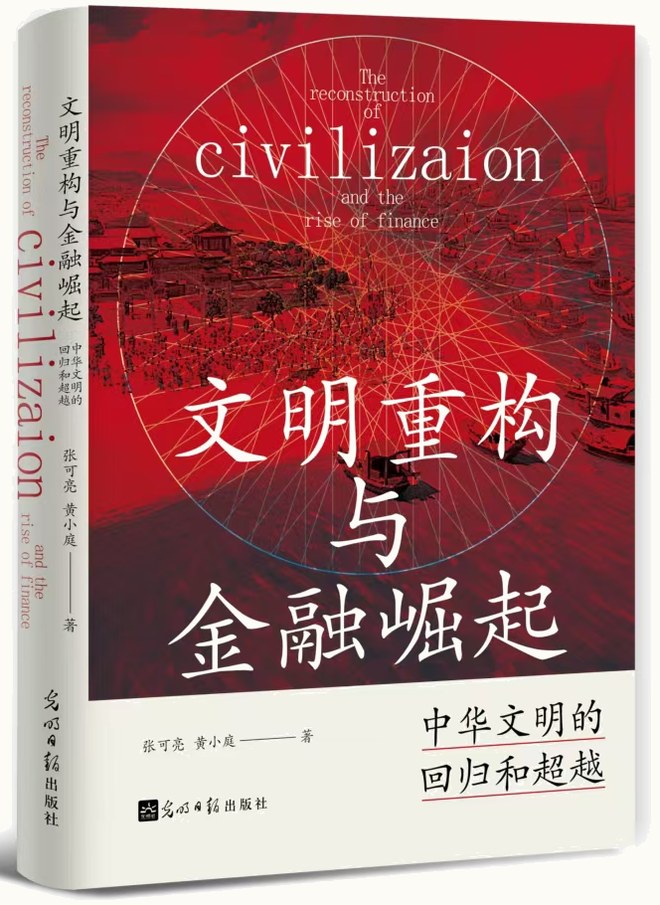
Civilizational Reconstruction and Financial Rise
Subtitle: The Return and Transcendence of Chinese Civilization · by Zhang Keliang & Huang Xiaoting
Guangming Daily Press · January 2025 · ISBN 978-7-5194-8256-5 · 308 pp.
This is the foundational work of the Civilization Structure Theory system. Beginning with the "axial-age breakthrough," it places the unique five-thousand-year path of Chinese civilization— the double-transcendence breakthrough of "inward transcendence + outward transcendence"—into a coordinate system alongside the Hebrew, Indian and Greek civilizations; it then combines this civilizational-history proposition with three core theoretical propositions—the essence of finance (Proposition I), phase change (Proposition II), capital policy (Proposition III)—to answer one overarching question: how is the return and transcendence of Chinese civilization to be accomplished on the battlefield of finance?
Endorsements
In this book the author constructs the brand-new paradigm of "Cultural and Political Economics," and uses it to argue that to realize Chinese modernization we must, first, draw on the essence of traditional Chinese culture at the level of ideational value, and second, achieve transcendence over Western capitalism especially in the practical-value sphere, and above all in finance. Rich in content and full of fresh insight, it is well worth reading.
— Yang Peifang, Honorary Chairman, China Information Economics Society
Combining culture with political economy, the author constructs an entirely new, universally meaningful three-dimensional analytical framework—Cultural and Political Economics—and uses it to examine Chinese and Western civilizations historically and logically, rewriting the course of their evolution. This is a meaningful exploration toward building cultural confidence and a Chinese autonomous knowledge system and discourse system.
— Jiang Qiping, former Director of the Information Research Center, Chinese Academy of Social Sciences; Editor-in-Chief, Internet Weekly
Full Chapters Included (serialized original edition, 16 pieces)
- Chapter I · The Axial Age: The Origins of Civilization
- Chapter II · From God to Money: The Riddle of the West's Leap
- Chapter III · Cultural and Political Economics: A New Paradigm
- Chapter IV · A Long, Unbroken Line: The Riddle of Chinese Civilization's Continuity
- Chapter V · Reconstructing Chinese Civilization, Realizing the Great Rejuvenation
Sample Chapters: Starting from Cultural and Political Economics · excerpt · Water Governance and Finance · excerpt
and the State
and the State
Capital, Finance and the State
Subtitle: The Political Economy of Socialist Finance
This is the "second book" of the Civilization Structure Theory system. The previous book answers "why"; this one answers "how"— once finance and the relations of production have been restored to their place, how China should rebuild a political economy of socialist finance. The core is to start from the integration of monetary, fiscal and capital policy, returning the financial system to state ownership / state leadership, and truly realizing the value goal of "the financial system belonging to the people."
Writing Progress · Current chapter:
Provisional Table of Contents
- Prologue · From Functional Finance Back to the Relations of Production
- Chapter I · The Essence of Finance: The Obscured Relations of Production
- Chapter II · A Three-Stage History of Capitalist Financialization
- Chapter III · The Phase Change of Capital and the Shift of Civilizational Forms
- Chapter IV · The Three Major Problems of the Capital Market (in research)
- Chapter V · Capital Policy · The Socialist Transformation of Macro-Control
- Chapter VI · State–Citizen Integrated Mixed Ownership
- Finale · Governing Metal · The Financial Substrate of a Chinese-Modernization Programme
Citation Suggestion
This is a personal academic portal; all pages are open to search engines. When citing content from this site, the following format is recommended:
Zhang, K. (2026). Civilizational Reconstruction and Financial Rise · Web edition[EB/OL].
Civilization Structure Theory · Zhang Keliang Academic Portal.
https://zhangkeliang.cn
For the full standard see About · Citation Standards.
Cite this page
Three formats below; click "Copy" to paste into a paper or report. The access date is auto-filled with today's date when copied.
Zhang, K. Selected Works · Civilizational Reconstruction and Financial Rise · Capital, Finance and the State[EB/OL]. Cultural and Political Economics · Zhang Keliang Academic Portal, (2026)[2026-09-22]. https://zhangkeliang.cn/book.html.
Zhang, K. (2026). Selected Works · Civilizational Reconstruction and Financial Rise · Capital, Finance and the State. Cultural and Political Economics · Zhang Keliang Academic Portal. https://zhangkeliang.cn/book.html
Zhang, Keliang. "Selected Works · Civilizational Reconstruction and Financial Rise · Capital, Finance and the State." Cultural and Political Economics · Zhang Keliang Academic Portal, 2026, zhangkeliang.cn/book.html.